
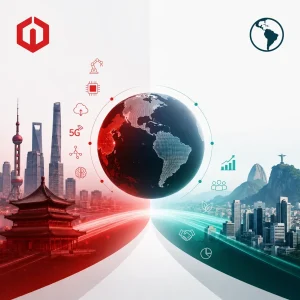
In 2026, ignoring Chinese technology is no longer an ideological stance — it’s a business mistake. DeepSeek has language models competitive with GPT-4 at a fraction of the cost. BYD outsells Tesla in LATAM. Temu has pricing no local retailer can match. Xiaomi beats Apple in market share across several countries in the region. These aren’t future threats — they’re happening now. The question for any company in Chile or Brazil isn’t «are the Chinese coming?» — it’s «what do I do with what’s already here?»
What you can use today
DeepSeek for AI costs: If you’re using GPT-4 or Claude Opus for high-volume text processing tasks — classification, summarization, data extraction — DeepSeek R1 and V3 offer comparable performance at 5-10x lower cost. For tasks requiring complex reasoning or creativity, Anthropic and OpenAI models remain superior. But for volume, the equation has changed.
Manufacturing and hardware: If your company buys electronics, light machinery, or operational accessories, Chinese suppliers on Alibaba and 1688 offer prices local distributors simply can’t match. The real cost includes import time, tariffs, and quality risk — but in many categories the margin is large enough to justify it.
E-commerce platforms: Shein and Temu have trained a generation of Latin American consumers to expect prices and delivery times that local retailers can’t match. If you sell physical products, you need to understand that your real competition isn’t the shop down the street — it’s a fulfillment center in Guangzhou with direct logistics to your city.
What you should fear (with evidence, not ideology)
Critical infrastructure dependency: The Huawei debate in telecommunications infrastructure isn’t just geopolitical — it’s operational risk. If your company depends on communications infrastructure or cloud services that could be subject to international sanctions, you need a contingency plan. This isn’t paranoia — it’s basic risk management.
Data and privacy: Chinese apps with massive user bases (TikTok being the most visible example) operate under different data regulations than European or Chilean law. If you use these platforms for marketing or collecting customer data, you need to understand exactly what data is being shared and with whom. Not as a political stance — as business due diligence.
Unsustainable price competition: Temu and Shein can operate at negative margins for years because they’re subsidized by growth capital. If your business competes directly on price with platforms that can sell below production cost, there’s no price to adjust — you need to reposition.
The pragmatic strategy
- Use what’s best and cheapest: if DeepSeek solves your use case at lower cost, use it. If Alibaba gives you access to suppliers that improve your margin, explore it. Technology loyalty without cost-benefit analysis is expensive.
- Don’t build critical dependencies on platforms with regulatory risk: use TikTok for marketing, but don’t make TikTok your only content distribution channel. Diversify.
- If you’re competing with Chinese products on price, stop: positioning through service, customization, local delivery speed, or direct customer relationships are the only sustainable advantages Chinese platforms can’t easily replicate.
Technology has no flag. What it has is cost, performance, and risk. Evaluating it on those three criteria — without ideology — is what separates companies that seize the moment from those that waste it.