

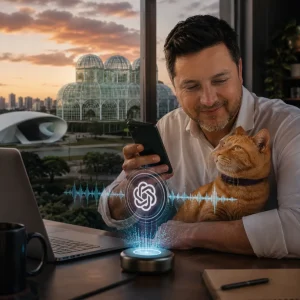
OpenAI launched GPT-Live on July 8, 2026, and the first thing I did was test it in a real voice call with ChatGPT. The difference from the previous voice mode isn’t subtle: for the first time, the AI listens and talks at the same time. Full-duplex, just like a regular phone call. No waiting for a beep to speak, no three seconds of dead air while the AI processes.
What I noticed testing it
I interrupted ChatGPT mid-sentence — the way you’d interrupt a colleague — and it stopped and listened without losing the thread. I asked it to slow down in the middle of an explanation and it did, without restarting the answer. It left silence when I was thinking through a response, instead of filling the gap with filler. It’s the first time a voice conversation with AI feels like talking to a person instead of using a walkie-talkie with a lag.
How it works under the hood
GPT-Live ships in two versions: GPT-Live-1, the full model for paid plans, and GPT-Live-1 mini, the lighter version that runs on the free tier and slower mobile connections. The voice model handles the natural flow of conversation, but when a query needs web search, longer reasoning, or a complex task, it delegates to GPT-5.5 behind the scenes and brings the answer back without a noticeable break. For now it’s only available in the ChatGPT app (iOS, Android, web) — the public API for developers has no confirmed date or price yet.
Why this matters for a B2B SMB
The bottleneck for AI voice agents was always the same: they sounded like a robot with rigid turns, and the customer noticed within the first five seconds. Full-duplex closes that gap. For a B2B business, this opens use cases that felt clumsy just a month ago:
- First filter for inbound calls: qualify a lead by voice without the person noticing they’re talking to AI in the first few seconds, before handing off to a human rep.
- Real multilingual support: combined with OpenAI’s translation models, the same voice flow can handle a customer in Portuguese and another in English without switching systems.
- Live call summarization: generate notes and next steps while the conversation is still happening, not after.
- Scheduling and confirmations: book appointments, confirm orders, or follow up post-sale with an interaction that doesn’t feel like a 2000s IVR.
The catch to watch
There’s still no public API or price for GPT-Live — it’s only in the ChatGPT app. If your business already uses OpenAI’s Realtime API for voice agents (GPT-Realtime-2), cost is billed per audio token, not per minute, which makes spend harder to predict unless you set limits from the design stage — the same cost-governance problem we already covered with AI agents in general. When GPT-Live reaches the API, apply the same discipline: a hard budget cap per call, not just per month.
What to do this week
If your SMB hasn’t tried ChatGPT’s voice mode yet, now’s the time: it’s free inside the app and gives you a concrete sense of how close conversational AI is to replacing the first phone touchpoint. Not to automate all customer support yet — but to stop thinking of «voice bot» as a synonym for a bad experience. That stage is already behind us.