

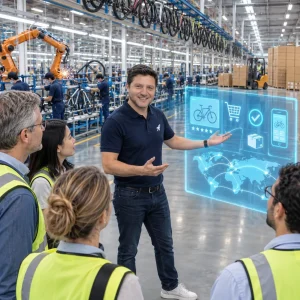
The bike boom is over. Bicycle ecommerce is only just getting started for real. After the 2020-2021 frenzy, the industry spent three years selling at 50% to 70% off to clear out overstock. By 2026 inventory is healthier, but the map has changed: brands born 100% online are opening physical stores, legacy distributors went bankrupt, and the fastest-growing business is refurbished used bikes sold over the internet.
If you sell bicycles, spare parts or accessories in Chile or Latin America, what’s happening in Europe and the United States serves as a preview. Here’s the summary with data, and what it means for your online store.
Online bicycle sales in 2026: the state of the market
The big picture is a market that has stopped falling but hasn’t recovered yet. Germany, Europe’s largest bicycle market, sold 3.8 million units in 2025, 3.9% fewer than in 2024, according to industry association ZIV. E-bikes now account for 52.7% of that market.
The figure that matters for ecommerce: in Germany nearly two-thirds of bicycles are still sold in physical specialty stores, but 24% are already sold in specialized online stores, and that channel is gaining ground while generic online (department stores, big marketplaces) retreats. In the first half of 2026, online retailer Bike24 grew 20.8% to 166.9 million euros, driven by gravel and road. Bicycle buyers do buy online, but they buy from someone who knows bikes.
On the manufacturers’ side the outlook remains tough: Giant reported revenue declines of 21.6% in January and 40% in February 2026. Distributors that got burned by overstock are no longer placing large advance orders.
Shimano: the thermometer for the whole industry
If you want to know how the bicycle business is doing, look at Shimano: its components are on most of the bicycles sold worldwide, whatever the brand. And its numbers tell the full story of the cycle.
- 2025, the year of the floor: the bicycle components division sold 355 billion yen, its first growth since 2022 (+2.7%), but operating profit fell 20.9%, hit by exchange rates and a sharp decline in China. Europe offset it.
- Weak start to 2026: the first quarter began with declining sales and operating profit cut in half.
- Third quarter 2026, the turning point: component sales rose 14.3% and segment profit more than doubled, from 6,500 to 13,400 million yen, as manufacturers’ inventories normalize. Shimano raised its annual forecast and expects to close 2026 with 371,500 million yen in bicycle components.
The takeaway: overstock is clearing and manufacturers are buying components again. But the recovery is uneven. In North America complete-bike sales remain weak due to tariffs, Europe holds steady, and Shimano raised prices on some components from August 2026 to offset costs. Part of the yen growth is also a currency effect.
In Chile: Shimano parts ways with its national distributor
On November 9, 2026, Andes Industrial announced in an official statement that its distribution relationship with Shimano in Chile ends on January 1, 2027. Until December 31, 2026, Andes remains Shimano’s exclusive distributor in the country and operates as normal. Andes retains a broad brand portfolio (Scott, Syncros, Vittoria, KMC, FSA, Kask, Magene, Amflow, among others) and announced «major projects and news.»
What’s next for Shimano in Chile? There’s no official announcement from the brand yet. According to industry sources, the split also extends to Peru, and Shimano would move to operate directly in the Chilean market, following the model it already applies in Peru, where it opened its own logistics operation in Lurín. It would also take over the Shimano product stock remaining in the distributor’s hands.
It’s the same trend we see worldwide: manufacturers are shortening the chain and moving closer to the point of sale. For Chilean bike shops, 2027 begins with a key supplier changing channels: new commercial terms, new supply timelines and, probably, a different way of placing orders.
In Brazil: Shimano already plays at home and e-bikes are soaring
Brazil is the counterexample to what is only just beginning in Chile. Shimano has had its own regional subsidiary, Shimano Latin America, based in São Paulo, since 2007, and distribution runs through Blue Cycle & Fishing, its exclusive distributor, which also handles warranties and trains mechanics. The brand organizes its own trade fair: Shimano Fest 2026, held in August in São Paulo, moved close to 80 million reais and is the industry’s main meeting point in Latin America. It’s the brand talking directly to shops and cyclists, with no intermediaries filtering the message.
The Brazilian market, moreover, is made at home. The Manaus Industrial Hub produced 335,560 bicycles in 2025, 4.9% more than in 2024, and mountain bikes are still nearly half. But the engine is electric: in 2025, 46,900 e-bikes were produced (about 14% of the total) and in the first half of 2026 their production rose 87.2%, while total production fell 9.6%. Google searches for «bicicleta elétrica» reached their highest level in five years in February 2026.
And ecommerce? Aliança Bike’s annual survey of 308 stores shows that the more revenue a store generates, the more likely it is to sell online, and that Mercado Livre is the dominant digital channel: more than 48% of stores that sell over the internet use it. Complete bicycles still account for 49% of average revenue, and the share of stores selling electric bikes rose from 47% to 54% between 2024 and 2025. Store owners view the 2026 economy with pessimism, but nearly half expect their own business to do better.
The lesson for Chile: when the brand operates directly, the store that wins is the one already selling online, with e-bikes on the floor and the ability to handle after-sales. Relying only on a marketplace like Mercado Libre works to get started, but the customer who comes back to the workshop is the one who becomes loyal to your own channel.
The post-pandemic hangover: who fell and why
The list of casualties over the past three years is long, and almost all share a common denominator: they grew on pandemic demand, took on debt or bought inventory as if that demand were permanent, and had no margin when the market normalized.
- VanMoof (Netherlands), the design e-bike sold direct to consumer, went bankrupt in July 2023.
- Wiggle and Chain Reaction Cycles, the two British giants of cycling ecommerce, fell into administration and Frasers Group bought the brands for less than 10 million pounds. It relaunched them in March 2024 as stores within its ecosystem.
- Rad Power Bikes, the largest D2C e-bike brand in the United States, filed for Chapter 11 in December 2025. The new owner announced it is leaving the direct-to-consumer model and moving to sales through stores.
- Accell Group, owner of Raleigh, Lapierre, Batavus, Sparta, Ghost and Haibike, entered insolvency in August 2026, with some 3,700 jobs at risk across 15 countries. Its brands are in the process of being sold.
What’s interesting is that both those who sold only online and those who sold only through distributors are falling. The problem wasn’t the channel: it was betting everything on just one and financing inventory with debt.
Direct-to-consumer vs. stores: everyone is moving to the middle
Canyon is the case study. The German brand that became famous selling high-end bicycles only over the internet closed 2025 with revenue of 738 million euros, about 6% less, and adjusted EBITDA 34% lower. Its response? Opening its own stores (Koblenz, Carlsbad in California and Munich), doubling its network of partner workshops to more than 600 locations and, since May 2026, a new CEO with an explicit mandate to enter third-party stores.
At the same time, traditional distributor brands (Trek, Specialized, Giant) have spent years building their own online sales, with pickup or assembly at the neighborhood store. D2C brands are seeking physical stores; store-based brands are seeking direct sales. They meet in the same place: omnichannel. A 2-million-peso bicycle gets researched online, but people want to try it, adjust it and have it serviced somewhere physical.
Tariffs in the United States: the other blow of 2025
Almost all bicycles and components in the world are made in China, Taiwan and Southeast Asia. With the 2025 tariffs, shipments of Chinese bicycles to the United States fell from about 9.5 million units in 2024 to nearly 2.7 million in the first half of 2025, according to figures from the U.S. International Trade Commission. Trek, Specialized and Giant raised prices, and Specialized added a 10% tariff surcharge.
For Latin America this has a practical reading: Asian stock that can’t enter the United States looks for other destinations. More supply and price pressure in markets like Chile, where China was already the main supplier (more than 60% of bicycle imports in 2022, according to Datasur).
What is growing: refurbished used bikes, e-bikes and specialized marketplaces
While new bicycle sales drag, the segment of certified used bikes sold online is taking off:
- Upway (Paris) refurbishes used e-bikes with a 50-point inspection and a one-year warranty, and delivers them to your door. It raised 60 million dollars in November 2025, doubled its global sales that year and aims to refurbish a million e-bikes a year by 2030.
- Buycycle (Germany), a marketplace for mid- and high-end used bicycles, already has more than 100,000 bikes listed and in 2025 expanded into other sports by acquiring the French company Everide.
The logic is simple: with more expensive new bikes and a huge pool of bicycles bought during the pandemic, there are millions of units looking for a second owner. Whoever builds trust into the process (inspection, warranty, delivery) keeps the margin.
What this means for a bike shop in Chile
Chile doesn’t have public statistics as granular as Germany’s, but the patterns repeat. Six actionable conclusions:
- Your physical store is your advantage, not your burden. Canyon is spending millions to open what you already have: a place to try, adjust and service bikes. Your ecommerce should push people to the store, with workshop scheduling, in-store pickup and assembly included.
- Specialize online. Growth is in specialized ecommerce, not in competing on price against Falabella or Mercado Libre. Product pages with geometry, sizes, spare-part compatibility and advice via WhatsApp sell more than a discount.
- Don’t buy inventory as if it were 2021. Smaller, more frequent orders, and an online store that shows real stock synchronized with the physical location so you don’t sell what you don’t have.
- Look at the used business. Taking bicycles in as trade-ins, checking them in your workshop and selling them online with a warranty is exactly what Upway and Buycycle do, but at local scale and with your own workshop.
- Prepare your operation for the Shimano change. If your store sells or installs Shimano components, secure stock of your fastest-moving items before year-end and have your online catalog ready to update prices, codes and availability when the channel changes in 2027.
- E-bikes and technical service go together. The e-bike customer needs battery, motor and software handled by someone. That after-sales service is your loyalty driver and your recurring margin.
In short: bicycle ecommerce is no longer «upload the catalog and wait.» The winner is whoever combines a specialized online store, a physical location and service. Exactly the model a neighborhood shop with a good workshop can execute better than a multinational.
Do you have a bike shop and want to sell online?
At Boostify we build online stores for specialty retailers: catalog with synchronized stock, workshop scheduling, in-store pickup, Chilean payment methods and WhatsApp-assisted sales. Message us on WhatsApp and we’ll review your case.